

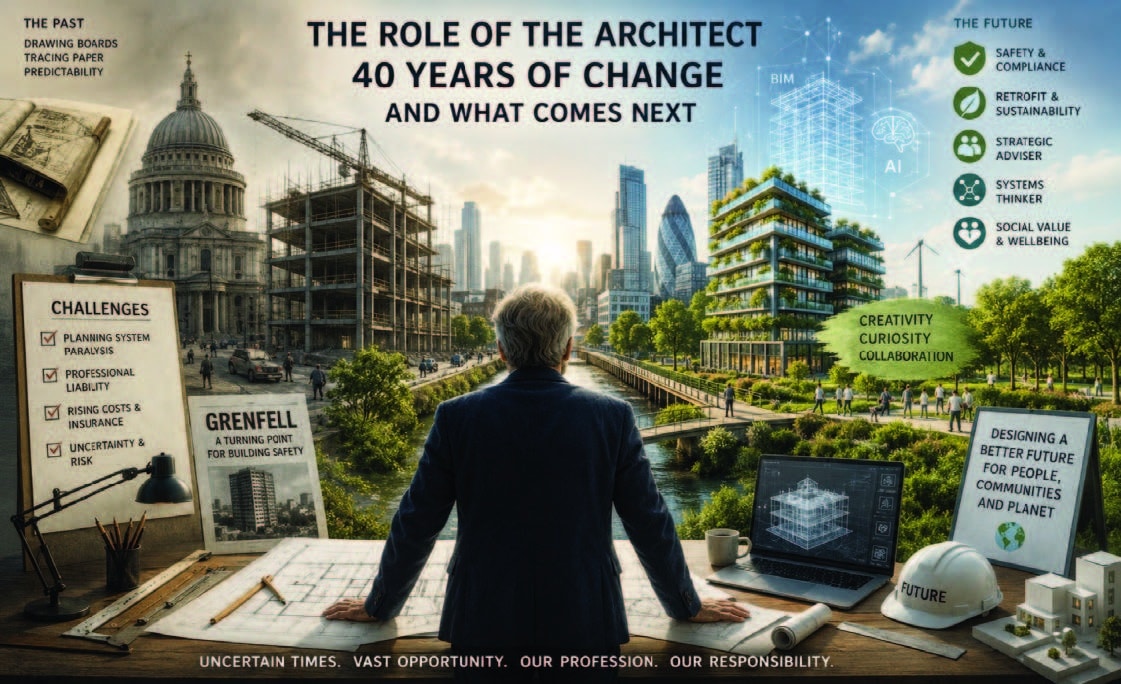
Philip Waddy writes: When I qualified as an architect over forty years ago, the world—and our profession—felt very different from today. It was a time of drawing boards, tracing paper, and a planning system that, while far from perfect, felt navigable—perhaps even predictable. There were no mobile phones and no email; communication was by telephone or post.
The architect was often seen as the conductor of the built environment orchestra: coordinating design, steering projects through their various phases from concept to completion, and shaping how buildings responded to the needs of society.
Over the decades since, the role of the architect has been reshaped—sometimes subtly, sometimes profoundly—by economic cycles, political shifts, globalisation, technological revolution and, tragically, catastrophic events such as the Grenfell Tower disaster. In this article, I reflect briefly on how the role has changed and, perhaps more importantly, how it may continue to evolve in the years ahead.
The Past 40 Years: A Profession in Constant Flux
Looking back, the last four decades read almost like a case study in volatility. For architects, it has often been a case of feast or famine. I have lived through recessions, boom times, financial crashes and other crises—from the growth of the Thatcher years, to the crash of the late 1980s, the boom of the early 2000s, and the global financial crisis of 2008–09.
More recently, we have endured Grenfell, COVID, the Russia–Ukraine war, and fresh geopolitical instability. Uncertainty feels ever-present.
Each of these moments has reshaped the work of architects, the risks we carry, and the expectations placed upon us. Today’s UK construction market—where vast demand meets weak economic appetite—makes the role more complex than ever. We face a kind of economic dissonance, where significant opportunities sit alongside substantial barriers to growth.
The Planning System: From Frustration to Paralysis
If one area illustrates the tension between opportunity and obstruction, it is the planning system. Forty years ago, planning could be frustrating, but it was generally functional. It was possible to call a senior planner in the local authority and obtain an informal view on a proposal.
Over time, the system has become more politicised, risk-averse, and burdened with detail. Today, it often feels like a bottleneck, constraining development, regeneration, and economic growth. The steady decline in resources and status within local authority planning departments has also had an impact: over half of RTPI members now work in private consultancy, whereas forty years ago planning consultants were virtually unheard of.
Successive governments have promised reform, but most changes have amounted to little more than incremental tinkering. The 2020 Conservative White Paper proposed radical reform—arguably the most ambitious since the Second World War—but ultimately delivered little. More recent proposals from the current Labour government, including revisions to the NPPF, contain some positive measures but fail to address the underlying issues of complexity, cost, and delay—particularly at the early stages of development.
For architects, the consequence has been a decade of stalled ambition. Housing need is immense—both in terms of new supply and retrofit—but delivery remains constrained. Increasingly, time is spent navigating uncertainty rather than designing solutions, and the cost of even a modest planning submission can far exceed the architect’s fee.
Unless the planning system becomes clearer, faster, and more predictable, our ability to shape the built environment will remain constrained by bureaucracy rather than enabled by creativity.
Grenfell and the Rise of Professional Liability
Perhaps the most significant turning point for the profession in recent years has been the Grenfell Tower disaster. It has rightly transformed expectations around building safety, but it has also placed a substantial burden of liability on architects.
The Building Safety Act has significantly increased administrative demands. Architects now spend considerable time verifying manufacturers’ product claims, certifications, and performance data—often encountering inconsistencies or gaps. This work is both time-consuming and costly.
At the same time, professional indemnity insurance premiums have risen sharply, leaving many practices—particularly smaller firms—feeling exposed. The architect has, in many cases, become the party that carries the greatest risk when things go wrong, despite fees not rising in proportion to responsibility. This imbalance is unsustainable, as evidenced by increasing insolvencies within the profession.
If society demands safer buildings—as it should—then risk must be more fairly distributed across the supply chain. Manufacturers, contractors, regulators, and clients must all share responsibility. Otherwise, we risk creating a system where the safest professional decision is not to design at all.
One potential solution would be the wider adoption of single-project insurance for major developments, helping to streamline risk allocation.
Technology: From CAD to AI and the Changing Nature of Practice
Over the past forty years, technology has transformed not only how architects work, but how clients think.
We have moved from drawing boards to CAD, then to BIM, and now into the era of artificial intelligence. The pace of change is unprecedented. The potential of AI is so profound that figures such as Mustafa Suleyman have suggested it may require a “new social contract” to address its economic and societal implications.
Technology is also reshaping demand. COVID accelerated hybrid working, transforming office requirements almost overnight. The rise of online retail has disrupted high streets while driving demand for logistics space. Meanwhile, the push toward net zero has moved retrofit and circular economy principles from the margins into the mainstream.
For architects, adaptability is now a core skill. The practices that will thrive are those that anticipate change, use data intelligently, and position themselves in emerging growth sectors.
Creativity, Curiosity, and the Role of Clients
One constant remains: architecture is fundamentally a creative, problem-solving discipline. Yet creativity is increasingly constrained by client anxiety, risk aversion, and, at times, a reluctance to engage with uncertainty—particularly in the housing sector.
The best outcomes arise from aspirational briefs, not rigid checklists. While some clients fear this approach may lead to “white elephant” projects, experience shows the opposite: well-managed creativity delivers long-term value.
The global demand for UK architectural services—now many times greater than when I began practice—demonstrates the value placed on design excellence.
What architects need from clients is curiosity: the willingness to explore possibilities before fixing a brief. The work of Urban Splash provides a compelling example of how this mindset can lead to both innovation and commercial success. Architects must advocate for this approach more confidently.
The Future Role of the Architect
Looking ahead, several shifts are already underway:
Architects as Stewards of Safety and Compliance
Post-Grenfell legislation will firmly embed architects within assurance processes, with greater responsibility for evidence, traceability, and compliance—ideally within a framework of shared accountability.
Architects as Retrofit Specialists
With climate imperatives and an ageing building stock, retrofit will become central to practice. Whole-life carbon assessment, circular materials, and adaptive reuse will become standard considerations.
Architects as Strategic Advisers
As uncertainty increases—from geopolitics to supply chains—clients will look to architects not just for design, but for insight: horizon scanning, risk analysis, and scenario planning, as explored in the RIBA’s Horizons 2034 programme.
Architects as Systems Thinkers
AI and data-driven design will shift the profession toward orchestrating complex systems rather than designing isolated buildings. Collaboration with technology specialists will become routine.
Architects as Champions of Social Value
In response to demographic change and inequality, architects must more clearly articulate how design improves lives, health, and wellbeing—not simply how it delivers space.
Conclusion: Carrying Responsibility, Sustaining Vision
The role of the architect today is more complex than at any point in my forty-year career. Responsibility has grown, liability has increased, and the environment in which we operate has become more uncertain.
And yet, our contribution has never been more necessary.
We stand at a pivotal moment. The built environment must evolve rapidly to meet social, environmental, and technological challenges. The need is immense, and so is the opportunity—but unlocking it will require courage, clarity, collaboration, and a simpler, more effective planning system.
If architects do not shape the future of the built environment, others will. And that is a prospect we should approach with caution. n
Philip Waddy RIBA ACA FRSA AABC qualified as an architect in 1982. In 1984, he established his own practice and, in 1986, acquired the Abingdon firm of Duncan West Architects. He later expanded into town planning consultancy in the 1990s. In 2015, he acquired the London practice of Archadia Ltd. and, until recently, was a director of West Waddy Archadia. He now works as a consultant offering planning, architectural, and heritage services.